Home / News / Coating Digest / What Is Tablet Coating? Why Manufacturers Coat Tablets
Tablet coating is the process of applying a thin layer of coating material to a tablet to improve swallowability, taste, appearance, or protection, and sometimes to control drug release. The coating material varies depending on the type of coating used and its intended purpose. Manufacturers use tablet coating when it serves a defined product goal; consistent results depend on the tablet core, coating formulation, and application process working together.
Key Takeaways
• Tablet coating applies a thin functional or cosmetic layer to a tablet without replacing a sound tablet-core formulation.
• A coating may improve swallowability, reduce unpleasant taste, protect against moisture or light, or provide a tailored release profile.
• Coating plays an integral role in drug release and absorption in the system.
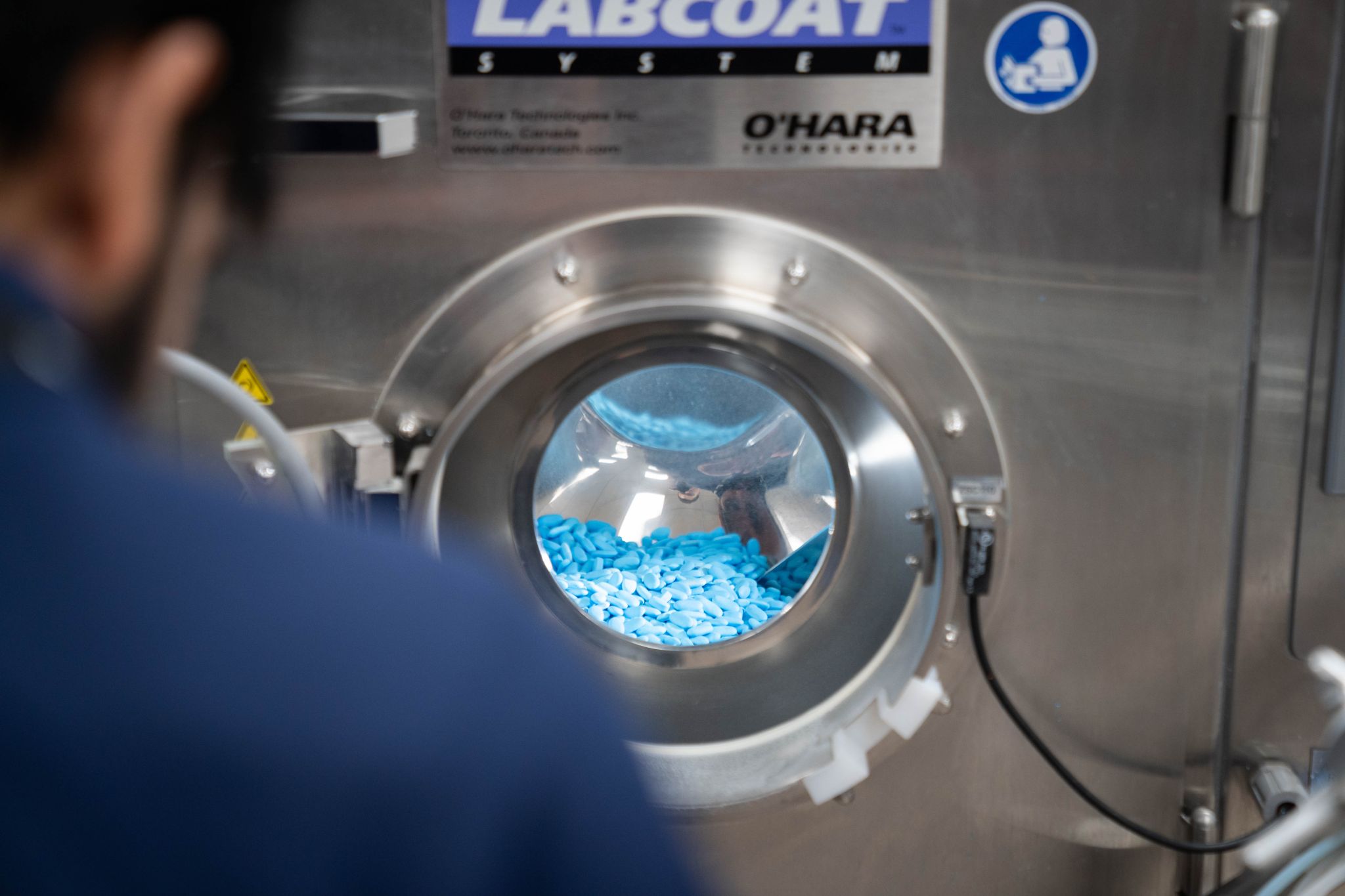
• In a perforated coating pan, tablets tumble as spray guns apply the coating liquid and controlled airflow removes the liquid carrier.
• Reliable scale-up depends on control of core quality, dispersion preparation, spray delivery, drying conditions, and equipment configuration.
Why Tablets Are Coated: Swallowability, Taste Masking and Protection
Manufacturers coat tablets to make an oral solid dose easier for patients to take and to give the finished product the properties its formulation requires. The reason might be as simple as a smoother surface, or as consequential as protecting a moisture-sensitive ingredient during its shelf life.
A smooth coating can make a tablet easier to swallow. A taste-masking film can reduce exposure to an unpleasant flavour before the tablet is swallowed. Colour and a more consistent surface can help a product look recognizable, although appearance alone does not establish product quality.
Protection is another reason. A formulation may require a coating that limits exposure to environmental moisture, light, or other conditions. That protection depends on the selected coating-forming materials, coating coverage, package and storage conditions; a coating does not automatically make every tablet moisture-proof.
Uniformity also matters in pharmaceutical manufacturing. Tablet coating usually occurs after compression, when much of the material and processing effort has already been invested. Avoidable colour variation, picking, sticking, or other surface defects at this stage may create rework or rejection risk. The correct goal is not simply to make tablets glossy. It is to meet a specification consistently.
Types of Pharmaceutical Coatings and Their Applications
Pharmaceutical coatings are classified by how they are applied, their intended function, the type of dosage-form core they cover, and the polymer systems used. Understanding these classifications helps formulation and production teams select suitable coating materials and processes for different pharmaceutical applications.
1. Coatings by Process Method
The application method determines how the coating is deposited onto the tablet or other dosage-form core. Common methods include:
- Film coating: Applies a thin, continuous polymer layer to tablets using a spray-and-dry process. It is widely used for generic medicines and other coated tablets, offering uniform coverage, shorter processing times, and compatibility with automated production.
- Sugar coating: Builds a thick, multi-layered coating through successive stages, including sub-coating, build-up, smoothing, colouring, and polishing. It provides effective taste masking and a distinctive glossy finish.
- Film powder layering: Combines spraying and powder dosing to build layers around particles or pellets. It is commonly used to apply active pharmaceutical ingredients (APIs) to inert cores and develop multi-component drug delivery systems.
- Hot-melt coating: Applies molten wax or lipid materials that solidify as they cool. Since this method does not require solvents, it is particularly suitable for moisture-sensitive APIs.
2. Coatings by Function
The functional purpose of a coating determines its formulation and performance requirements. These coatings fall into two broad categories:
- Non-functional coatings: Primarily improve a medicine’s appearance, handling, and patient acceptability. They include aesthetic or brand-identity coatings, taste and odour masking, ease-of-swallowing films, basic moisture protection, and photostability coatings that protect against light exposure.
- Functional coatings: Designed to modify a medicine’s drug-release profile or provide specific protective properties. They include enteric (gastro-resistant), extended or controlled-release, pulsatile-release, functional moisture-barrier, and active ingredient layering coatings.
These coating categories serve different purposes and are not interchangeable. For example, a coloured film coating does not automatically provide enteric protection or modified drug release. Similarly, coatings designed to control drug release or provide functional moisture protection must meet specific performance requirements. Formulation and quality teams should therefore establish the intended coating function before selecting the appropriate materials and manufacturing equipment.
Selecting the right pharmaceutical coating involves more than choosing a suitable material or manufacturing machine. Product development should begin with clearly defined quality attributes and the desired product performance. The International Council for Harmonization (ICH) Q8(R2) Pharmaceutical Development guideline, published as U.S. Food and Drug Administration (FDA) guidance in November 2009, provides a framework for linking formulation and manufacturing process knowledge to product quality and performance.
How a Coating Material Is Applied in a Perforated Coating Pan
Coating is applied in a perforated coating pan by tumbling tablets through a controlled spray zone while conditioned air removes the liquid carrier. The aim is to distribute small amounts of coating across many tablet passes, building a uniform coating layer without leaving the bed too wet or drying droplets before they reach the surface.
- Load an appropriate quantity of tablets, establish pan motion, and bring the tablet bed to the selected operating conditions.
- Prepare a coating dispersion or solution using the formulation’s specified mixing order, concentration, and hold conditions.
- Atomize the coating liquid using spray guns positioned to cover the moving tablet bed without excessive overlap or overspray.
- Supply and exhaust conditioned air so evaporation keeps pace with liquid application while protecting tablet and film quality.
- Continue until the required coating endpoint is reached, then complete cooling, unloading, sampling and documented checks.
Spray rate, atomizing air, pattern air, bed temperature, pan speed, and drying capacity must work together. For example, too much liquid for the available drying can cause sticking; too much drying before droplets reach the bed can lead to a rough surface. The optimal settings are specific to the formulation and equipment, so scale-up is not a matter of copying a lab recipe unchanged.
For a production example, O’Hara Technologies’ Fastcoat™ fixed-pan coating systems use fully perforated drums, the O’Hara Professional Coating Arm (PCA), and remote air handling with dehumidification and HEPA filtration, with pre-heat and humidification available. The equipment is the platform; the controlled coating process determines whether the final film meets its target.
What Has to Go Right: The Core, the Dispersion and the Equipment
Successful tablet application depends on three elements aligning: a tablet core that withstands tumbling, a dispersion that sprays predictably, and equipment that controls movement, application and drying. A weakness in any one of them can manifest as a visible coating defect or an out-of-specification result.
- The tablet core: Core hardness, friability (tendency to chip or crumble), shape, and embossed logos affect how a tablet moves and accepts a film. A fragile edge can erode before coating is complete; deep or narrow logos can increase the risk of bridging.
- The coating dispersion: Polymer grade, pigments, solids content, and mixing and hydration influence viscosity and spray behaviour. A viscosity that is too high can contribute to a rough, orange-peel surface. Follow the coating supplier’s formulation and preparation instructions.
- The equipment and recipe: Gun position, droplet formation, exhaust and inlet air, humidity, tablet-bed motion, and repeatable control settings influence deposition and drying. Record the process conditions that produce acceptable results, then check them again when the batch size or coater changes.
When a process changes, assess the impact on product quality rather than assuming a single setting caused the problem. The FDA’s ICH Q9(R1) Quality Risk Management guidance (May 2023) outlines principles and tools for managing pharmaceutical quality risks.
O’Hara has designed and manufactured tablet coaters in Richmond Hill, Ontario, since 1976. In September 2026, O’Hara co-hosted Tablet Coating School 2026 with Colorcon® in Richmond Hill, bringing formulation and equipment expertise together: you need the right coating, but you also need a process that can apply it reproducibly.
Matching Your Coating Goals to the Right Equipment
Match your equipment to the coating function, batch size, throughput, and control requirements before comparing machine features. A coater for development trials is not automatically the best choice for a commercial product, and a higher nominal capacity is useful only if it fits the upstream and downstream lines.
For formulation and early development, our Labcoat™ benchtop coating systems cover 0.17 kg to 0.54 kg, giving teams a practical starting point for small batches. To accommodate higher laboratory batch sizes, our Labcoat™ GEN II provides expanded capacity from 0.17 kg to 15 kg. For larger-scale development and scale-up, Pilot Labcoat™ systems extend capacities from 3 kg to 130 kg. Overall, our comprehensive R&D portfolio spans batch sizes from 0.94 kg to 153 kg.
For commercial campaigns with varied products or batch sizes, compare batch tablet coating systems against your changeover needs, cleaning approach, and available space. O’Hara’s Fastcoat™ fixed-pan systems cover 150 kg to 1200 kg; interchangeable-pan options can provide additional flexibility when batch sizes vary.
For sustained, high-volume manufacturing, continuous tablet coating systems featuring O’Hara’s patented continuous coating technology may be worth evaluating alongside batch coating. The Fastcoat™ continuous range includes FCC 75, FCC 250, FCC 500 and FCC 1200 models, with nominal throughputs ranging from 75 kg/hr to 1200 kg/hr. Actual production suitability depends on the product, target weight gain, line integration, and the validated operating range.
Before making an equipment decision, document the required coating function, tablet dimensions, target coating weight gain, expected output, containment and cleaning requirements, and relevant data integrity and validation requirements. Where possible, ask the supplier to run your tablets in a test facility before you commit. A well-matched selection delivers repeatable results throughout its working life, with access to parts, training, and service support.
Frequently Asked Questions
What is the difference between non-functional and functional coatings?
A cosmetic coating primarily changes appearance, surface feel, or taste, while a functional coating is selected to meet a defined performance goal such as moisture protection or controlled release. The categories can overlap: one film may do more than one job. The distinction is whether the product specification requires an effect beyond appearance and whether testing demonstrates that effect.
Does the coating formulation affect which machine I should buy?
Yes. Continuous coaters hold tablets for only about 15 minutes, so higher-solids coatings (up to 35%) help reach the target weight gain without slowing the feed. Ask suppliers which coating systems they have tested on their equipment.
Does a film coating change how a drug is released?
Yes, some film coatings are designed to modify drug release, but many immediate-release films are not. Delayed-release or enteric systems can be formulated to resist release under gastric conditions, while other modified-release designs control release over time. Whether a particular tablet behaves that way depends on its complete formulation and verified dissolution performance, not on the presence of a film alone.
Can I develop a process at lab scale and scale it up?
Yes. O’Hara designs its range so a process developed at the bench carries into production. Start on the Labcoat Benchtop, then move to the Labcoat M for formulation and clinical batches. For continuous coating, a lab coater can be set up with a shallower bed and matched airflow to model a segment of the FCC 500.
Production then runs on the FCC family, from 75 to 1,200 kg/hr nominal. Each FCC can also run as an automated batch coater, so batch size is set by run time rather than pan size.
Conclusion
Tablet coating works when the chosen film serves a clear purpose, and the process applies it consistently. Whether for swallowability, moisture protection, or controlled release, the tablet core, coating formulation, and equipment must be considered together. Our focus is consistent coating from the first lab batch through full production, backed by certified spare parts, site services, operator training, and retrofit support. Get Your Coater Recommendation to explore a configuration that fits your tablets, output goals, and process needs.